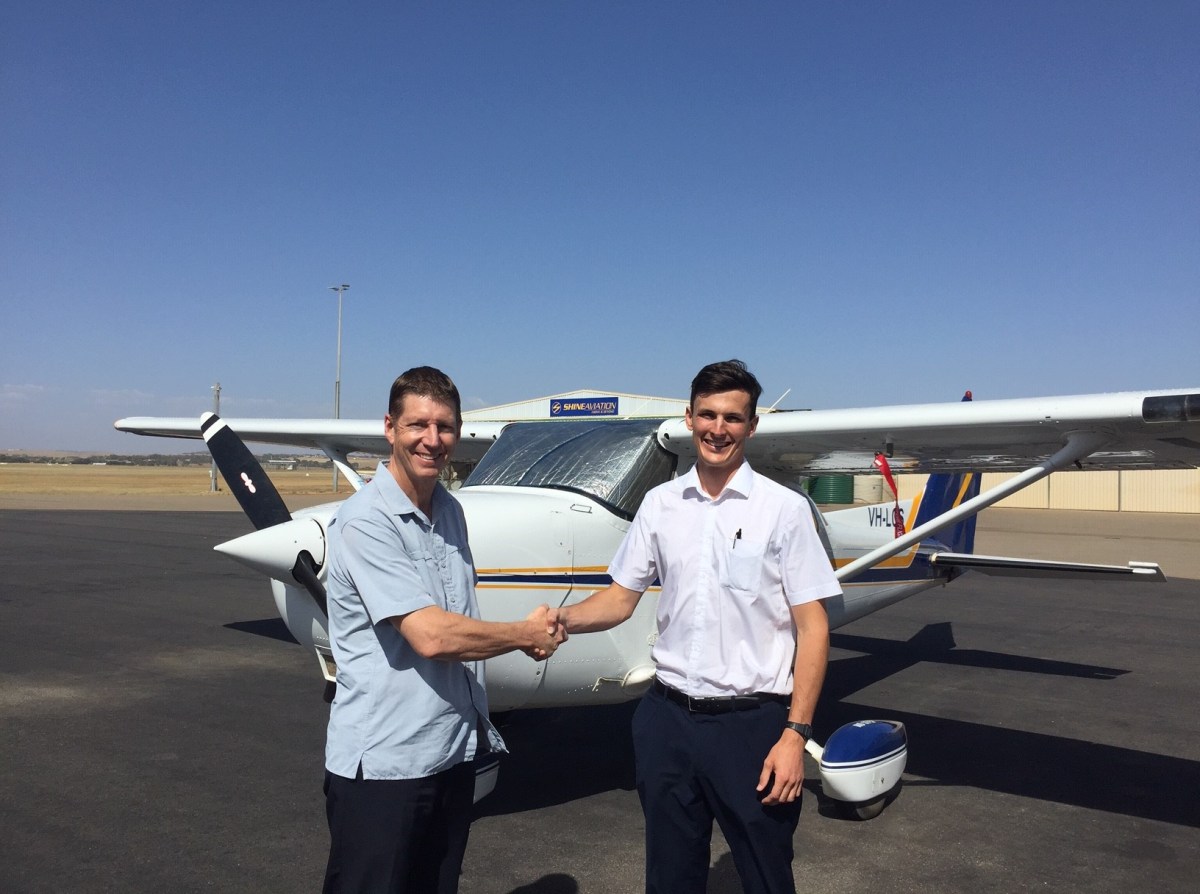
Flight Training
1 - Flight Training
We are now pleased to be able to offer the services of our flight school in both Geraldton and Carnarvon.
We opened our Carnarvon Flight School on the 15th October 2010 and are now able to offer the opportunity to learn to fly and licenced pilots to undertake their Annual Flight Review in Carnarvon.
Learning to fly is an exciting experience that will leave you not only with a great sense of achievement but also a licence to a whole new world.
Gaining your private pilot's licence can be done in as little as three months or completed over a longer period of time ie 12-18 months. It is totally your decision and can be scheduled to fit both your time and budget. This is the first step to take if you choose to proceed toward your Commercial Pilot Licence (CPL).
Shine Aviation flight school is ideally located. Due to the good weather conditions we experience in Geraldton and Carnarvon and the uncluttered air space in our region, our students' flight time is rarely interrupted. Less holding time on the tarmac means our students gain more time in the air and greater value for money.
Shine Aviation currently have six experienced Instructors (who are all IFR Charter Pilots) and are authorised to conduct all Exams and Flight Tests "in house".
We pride ourselves on offering a personalised, high standard of training because we realise the significant investment that students make in obtaining their Licences.
2 - Getting Started
Prior to commencing your training it is recommended that you have an aviation medical and complete an application for the Student Pilot Licence (SPL) and ASIC (Aviation Security Identification Card). This is due to delays of up to 6 weeks in CASA processing your application.
Our highly qualified instructors are available to discuss the application process with you and provide all application forms to be completed to get you started.
You can obtain all text books initially required from Shine Aviation.
For further details regarding training and associated costs, please contact us on 08 9923 3600 or email - admin@shineaviation.com.au.
3 - GFPT
Just think after only approximately 10 hours of training you could be flying "SOLO".
GFPT – General Flying Progress Test basically qualifies you to fly with passengers within 10 miles of the airport in which you have learnt to fly. The CASA minimum of 20 hours of flight training must be undertaken, (including hours in Command and Instrument experience).
However please note that some students may require 30-40 hours of training before gaining their GFPT Licence, as skill levels and application play a large part in keeping the required hours to the course minimum.
This licence consists approximately of:
Prior to commencing your training it is recommended that you have a aviation medical and complete an application for the Student Pilot Licence (SPL) and ASIC (Aviation Security Identification Card). This is due to delays of up to 6 weeks in CASA processing your application.
For further details regarding training and associated costs, please contact us on 08 9923 3600 or email - admin@shineaviation.com.au.
4 - PPL
PPL – Private Pilot Licence allows you to fly to other airports anywhere in Australia. The CASA minimum of 40 hours of flight training must be undertaken, (including hours in general command, cross country command and instrument experience).
However please note that some students may require 50-60 hours of training before gaining their PPL Licence, as skill levels and application play a large part in keeping the required hours to the course minimum.
This licence consists approximately of:
5 - Commercial Pilot Licence (CPL)
The CPL flight test may be attempted after completing 150 hours training (if you have followed the integrated training syllabus) or 200 hours total flight time and having passed the required theory exams. The training is designed to make you a better pilot than you were at the PPL stage. Navigation techniques are the same, however a commercial pilot is expected to have a better understanding of the environment and the aircraft. You will be able to make better, safer decisions and will be more efficient in your flight planning and flight conduct. A CPL permits you to be employed to fly for hire or reward.
6 - Night VFR
Flying at night is a whole new experience for the visual pilot. To fly by the moonlight and gaze at the bright sea of stars of a clear night in the country, a Night VFR rating allows you to fly at times more convenient to you. This means you can leave later to make a night arrival back at home, or depart before dawn, for an earlier arrival at your destination.
Your Night VFR rating will extend your flying skills, including the use of navigation aids (NDB, VOR and GPS), plus the use of runway lighting equipment such as PAL (Pilot Activated Lighting)
The Night VFR training includes the following:
- Night Flying Theory
- Circuit Training
- Navigation Aid Training
- Instrument Flying
- Visual Navigation Exercises
In addition you will be instructed on the use of GPS.
The flying component of the course is as follows:
- Circuits (1.0hr)
- Circuits (1.0hr)
- Simulator Training (1.0hr)
- Navaid Training (1.0hr)
- Navigation Exercise 1 (2.5hr)
- Navigation Exercise 2 (3.0hr)
- Instrument Flying (0.5 hr)
The NVFR flight test is approximately 2.5 hrs.
Call Shine Aviation to discuss adding the Night VFR rating to your Private Pilots licence or including it in your Commercial Pilots licence training.
7 - Twin Endorsements
If you are looking for a career in General Aviation or the Airlines you will most likely need a Multi Engine Aircraft Endorsement.
Shine Aviation offers pilots seeking their initial or subsequent multi-engine endorsement the P-68 Partnavia and B-58 Beechcraft Baron.
Multi Engine aircraft normally have higher performance than single engine aircraft and require more skill and a higher level of decision making.
Your Initial Multi Engine endorsement will teach you the drills, emergency procedures and handling characteristics associated with asymmetric flight (flight on one engine). This course provides you with the specific skills required to safely and accurately operate a twin-engine aircraft. While each type of twin engine aircraft requires a specific type/class endorsement, your initial endorsement will allow you to quickly transition to other types in the future.
It is generally thought that two engines are better than one – this is not always case! In many light multi-engine aircraft having an engine failure can result in it being more of a challenge than a single engine aircraft, and a positive rate of climb may not be always be possible.
Your initial multi-engine type rating course consists of two main components:
- Multi-Engine Theory
- Multi-Engine Flight Training
Your training will be based on the Civil Aviation Advisory Publication (CAAP) 5.23 relating to Multi-Engine Airplane Operations and Training.
Flight Training and Experience Requirements
Your flight training will cover the following aspects of multi-engine operations. Theory covering these topics will be delivered through classroom briefings before flight.
- Procedures
- General Handling
- Advanced Handling
- Circuits
- Introduction to Asymmetric Flight
- Critical and Safety Speeds
- Asymmetric Performance
- Instrument Flying
CAAP 5.23-2 recommends 7.0 hours for the initial Multi-Engine Endorsement, this will vary depending on your experience, our friendly Chief Flying Instructor (CFI) will be able to tailor a program to suit you.
Having obtained your initial multi-engine type endorsement subsequent endorsements can typically be completed in less time; call our CFI to discuss a program for you.
8 - Instructor Training
Not currently available. This will be available in the first half of 2011 so keep checking this site for updates.
9 - Instrument Training
Not currently available. This will be available in the first half of 2012 so keep checking this site for updates.
10 - Synthetic Trainer
The ELITE AIRTRAINER MODEL AT-21 is an approved synthetic trainer used mainly for flight instruction and IFR currency. The simulator can be used as a trainer for the C172R/182S, Beech Bonanza A36, Beech Baron 58, Piper Seneca III, Piper Archer III, and the King Air B200.
The following training can be carried out on this trainer:
- Basic instrument flying
- Instrument letdowns (NDB, NDB/DME, VOR, VOR/DME, Twin Locator, GPS/DME arrivals, RNAV (GNSS)and ILS/LLZ)
- Standard Instrument Departures and Arrivals
- Cross country instrument flight
- Recency requirements IAW CAO 40.3
Predominately used for training and maintaining staff currency, it is also available for dual instruction at very reasonable rates.
|